
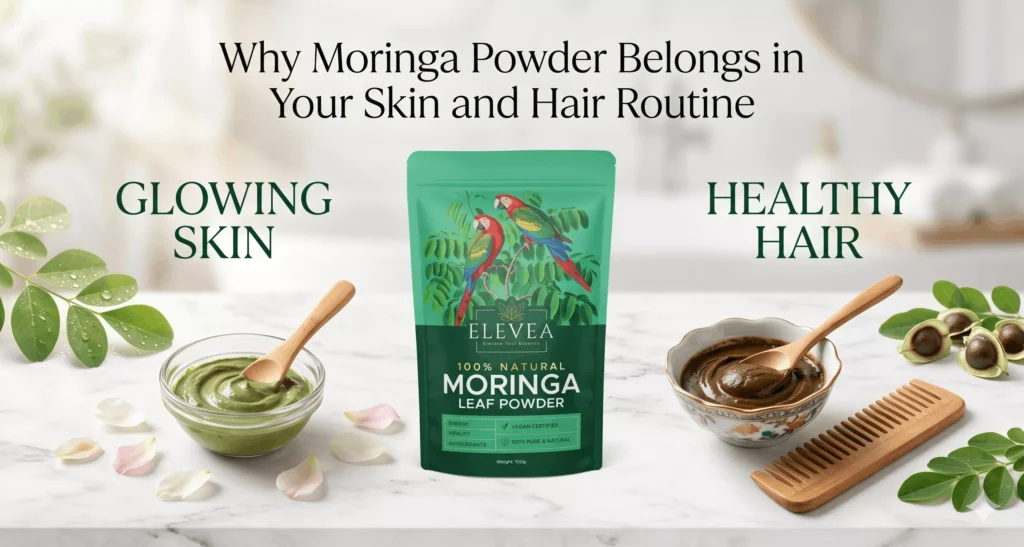
What the research actually shows, and what thousands of people are saying
Reviewed by Dr. Mukesh Ravala, MRCGP CCT UK| April 2026
A note on how we write at ELEVEA
We believe you deserve clear and honest information, not hype or exaggerated claims. In this article, we explain exactly what clinical studies have proven, what is supported by real-life experiences but still needs more research, and what we simply do not know yet. This level of honesty is what we stand for.
The plant behind the powder
Moringa oleifera, often called the ‘miracle tree’, grows naturally in the sub-Himalayan areas of northern India and has been grown for many years across tropical regions of South Asia and Africa. The leaves are carefully picked, gently dried, and then ground into the fine green powder you see in ELEVEA’s products.
This is not a new discovery. Moringa has been used in Ayurvedic and Unani medicine for thousands of years, including for applying on the skin. Modern science is now slowly catching up with this long history of traditional use.
If you’re looking for a clean and tested option, you can explore ELEVEA Moringa Powder on Amazon
What moringa leaf powder actually contains
Here is what laboratory testing has consistently confirmed, based on multiple peer-reviewed research studies:
| Nutrient / Compound | Amount in dried leaf powder | Why it matters for skin and hair |
| Vitamin A (as β-carotene) | 16–40 mg / 100g | Supports normal skin cell function, via its vitamin A content |
| Vitamin E (α-tocopherol) | 63–134 mg / kg | Acts as an antioxidant and contributes to the protection of cells from oxidative stress |
| Vitamin C | Present in fresh leaves; reduced after drying — do not rely on moringa powder as a vitamin C source | Useful when eaten fresh; very limited effect when applied to skin |
| Iron | 21–28 mg / 100g | Iron contributes to normal energy-yielding metabolism when consumed as part of the diet. |
| Calcium | 894–2,645 mg / 100g | Supports bone health and important cell functions |
| Quercetin & Kaempferol | Well-studied plant compounds | Show antioxidant and anti-inflammatory activity in lab and animal studies, not yet confirmed in human skin trials |
| Oleic acid (in seed oil) | 65–79% of seed oil fatty acids | Helps moisturise and soften skin; useful in oil-based products |
| Amino acids | All 9 essential amino acids present; low in cysteine and methionine | Supports overall nutrition; limited proven benefit for hair when applied on skin |
Sources: González-Burgos et al., 2021 (Nutrients); Kamal et al., 2020 (Heliyon); Čolović et al., 2023 (South African Journal of Botany); multiple independent laboratory analyses.
Important: raw powder vs. formulated products
Studies that showed benefits for the skin used a standardised 3% moringa leaf extract in a cream, not raw powder applied directly on wet skin. A well-made cream helps maintain the right concentration, keeps the pH stable, and improves how well it is absorbed into the skin. DIY masks made from raw powder can still provide some moisture, but they should not be expected to give the same results as properly formulated skincare products.
Moringa for skin: what the evidence shows
1. Skin hydration and texture
The best available human research comes from two small pilot studies by Ali, Shah and Akhtar (2014), published in the journal Postepy Dermatologii i Alergologii. In these studies, a standardised 3% moringa leaf extract cream was applied twice daily by eleven healthy volunteers over a period of three months. Researchers used proper measuring tools to study changes in the skin and found:
- Clear improvements in skin roughness, smoothness, and dryness
- Noticeable reduction in wrinkle depth
- No irritation or negative side effects in any participant
A second study (Athikomkulchai et al., 2021, Cosmetics, n=32) using a moringa seed oil cream also showed clear improvements in skin hydration after four weeks of use.
What ELEVEA says honestly
These studies are small and are considered early-stage research. They are still very encouraging, and we see positive signs from them. However, they are not large clinical trials that allow us to make strong final claims. What we can say with confidence is that moringa-based products are generally well-tolerated and show positive results for hydration and skin texture in the human studies done so far.
2. Antioxidant protection
This is one of the most strongly supported benefits of moringa. Many independent laboratory tests confirm that it has strong free-radical fighting ability. This comes from compounds such as quercetin, kaempferol, chlorogenic acid, neohesperidin, and β-carotene.
A 2025 cell-based study (Li et al., PMC12291669) showed that moringa leaf extract helped reduce damage caused by ultraviolet (UV) exposure in human skin cells grown in the lab. It also reduced markers linked to collagen breakdown (MMP-1, MMP-3, MMP-9). Another study by Baldisserotto et al. (2018, Molecules) showed that moringa extracts at 2–4% concentration helped stabilise commercial UV filters better than the commonly used stabiliser octocrylene.
What this means in simple terms: the antioxidant compounds in moringa are real and well studied. However, we do not yet fully know how well these compounds pass through the skin when used in a DIY powder mask. In properly formulated skincare products, there is good reason to expect antioxidant benefits. This is still an active area of research.
3. Soothing and anti-inflammatory properties
Reducing inflammation is one of the most consistently reported effects of moringa in scientific research. Important findings include:
- Cretella et al. (2020, Journal of Ethnopharmacology): applying moringa seed oil on the skin reduced inflammation in a mouse study by activating glucocorticoid receptors, without causing skin thinning like steroid creams
- Choi et al. (2016, Biomedicine & Pharmacotherapy): moringa leaf extract reduced inflammation markers (TNF-α, IL-1β, IL-6) in a mouse model of eczema-like skin
- A 2025 umbrella review of 26 studies confirmed that moringa works through known pathways like NF-κB suppression and Nrf2 activation (PMC12127422)
These effects are clearly proven in lab and animal studies. However, more human studies specifically focused on skin inflammation are still needed.
On redness and sensitive skin
Many ELEVEA users with sensitive or easily irritated skin say that moringa feels calming and gentle when applied. This matches the anti-inflammatory effects seen in research. We consider this real-life experience important, while also waiting for stronger human clinical studies. If you have a diagnosed condition such as eczema or rosacea, it is best to speak with a dermatologist before using any new skincare ingredient.
4. What about spots and acne-prone skin?
We want to be completely honest here, because accuracy matters more than making sales.
Moringa contains compounds that have shown antibacterial effects in laboratory testing, and its anti-inflammatory properties are well supported by research. Many people with acne-prone skin say that moringa feels gentle and does not irritate their skin.
However, the only clinical study that directly tested moringa for acne (Shah & Akhtar, 2013) involved 11 healthy male participants and only measured oil (sebum) levels — not actual acne spots. A more recent 2025 randomised study comparing moringa seed oil with benzoyl peroxide (n=60) found no statistically significant reduction in acne lesions when using moringa.
This does not mean moringa has no use for acne-prone skin. It simply means we cannot claim that moringa treats or reduces acne. What we can say is:
- Moringa is generally safe to use when patch tested
- Its anti-inflammatory effects may help skin feel calmer
- Many people with acne-prone skin include it in their routine without problems
- It should not replace medically approved acne treatments
ELEVEA’s position
We do not claim that ELEVEA Moringa Powder treats or reduces acne. If you are dealing with acne, you should consult a GP or dermatologist. Moringa may be a helpful addition to your routine, but it is not a treatment.
5. Appearance of fine lines and skin texture over time
The study by Ali & Akhtar (2014) showed that after three months of regular use, people using the 3% moringa cream experienced measurable improvements in wrinkle depth and overall skin surface quality compared to the beginning of the study. In addition, lab-based studies show that moringa compounds can slow down collagenase and elastase, enzymes that break down collagen and elastin in the skin.
These results are encouraging and worth noting. However, they are still early findings. Larger human studies have not yet been completed. We present this information clearly: early results are positive, but more research is still needed to confirm long-term effects.
Moringa for hair: what we know and what we’re still learning
The evidence base for hair
There are currently no published human clinical studies on moringa for hair care as of April 2026. This is a clear fact, and we will not present it differently. However, other types of evidence do exist:
| Evidence type | What it found | What it means |
| Animal study (Junlatat & Sripanidkulchai, 2022) | Moringa seed oil helped increase hair growth in mice; it increased VEGF gene activity (linked to blood supply to hair roots) | Shows promising biological effects, but not yet proven in humans |
| Animal study (Ola et al., 2023) | Moringa seed oil reduced hair loss caused by DHT in rabbits | Suggests a possible DHT-blocking effect, but human proof is needed |
| In-vitro (cell culture) | Moringa compounds increased activity of growth-related genes in skin cells | Supports possible mechanisms, but not real-world clinical results |
| Lived experience (consumer reports) | Commonly reported effects include softer hair, less frizz, a calmer scalp, and better manageability with regular use | Strong real-world feedback, but not controlled scientific data |
| Oleic acid content (seed oil) | 65–79% oleic acid — a well-known moisturising fatty acid | Provides real moisture and coating benefits for the hair shaft |
What people are actually experiencing
Across UK and global beauty communities, including textured hair groups (types 3A-4C), natural hair forums, and Ayurvedic wellness circles, common patterns appear among moringa users:
- Hair feels softer and easier to manage with regular use
- The scalp feels less itchy or irritated
- Frizz is reduced, especially in dry or cold weather
- Curly and coily hair types report better moisture retention
- Hair looks shinier after using masks or oil treatments
These experiences are meaningful because they come from real users. However, they are not controlled clinical studies. We do not present them as scientific proof. Still, real-world experience is valuable, especially when research has not yet fully explored a traditional ingredient.
On moringa for scalp health
Moringa seed oil has shown antifungal activity against Malassezia furfur – the fungus most commonly linked to dandruff in laboratory tests, with inhibition zones ranging from 14.5 to 26.3 mm. Many users report that regular use of moringa oil reduces scalp flaking. This combination of lab evidence and real-world experience is promising, but controlled human studies on dandruff have not yet been published.
How to use ELEVEA Moringa Powder
For skin
Hydrating and texture-improving mask
What the research supports: the Ali & Akhtar (2014) study showed improvements in skin texture after regular use of a moringa-based formulation. Honey is also known to attract and retain moisture in the skin.
- Mix 1 teaspoon of ELEVEA Moringa Powder with enough raw honey to make a smooth paste
- Apply evenly to clean skin, avoiding the area around the eyes
- Leave it on for 10–15 minutes, then rinse off completely with warm water
- Use 1–2 times per week for best results, natural ingredients work gradually, not instantly
Antioxidant-supporting daily blend
For those who prefer daily use, you can mix a small amount into your regular moisturiser or facial oil. Moringa seed oil, which is rich in oleic acid, works especially well for this purpose.
- Add 1–2 drops of moringa seed oil (or a small pinch of powder) to your usual moisturiser
- Apply to clean skin in the morning or evening
- Use this as an addition to your routine, not as a replacement for proven skincare products
For hair
Deep conditioning mask
This follows the known effect of oleic acid as a moisturising agent for the hair shaft:
- Mix 1 tablespoon of ELEVEA Moringa Powder with warm water, yoghurt, or aloe vera gel to form a paste
- Apply to the scalp and along the lengths of the hair; avoid applying directly to broken or irritated scalp areas
- Leave for 20–30 minutes, then wash out using a mild shampoo
- Using this once or twice per week is enough for most hair types
Scalp oil blend
- Mix moringa powder or moringa seed oil with a carrier oil such as coconut, jojoba, or castor oil
- Warm the mixture slightly and massage it into the scalp
- Leave it on for at least 30 minutes before washing it out
- Many people with curly and coily hair types find this especially helpful for keeping moisture in the hair
For best results, always use a high-quality product like ELEVEA Moringa Powder (available on Amazon).
Who can use ELEVEA Moringa Powder?
Moringa powder is generally well tolerated by many different skin and hair types, based on available safety information. The following table explains suitability clearly:
| Who | Suitability | Notes |
| People looking for plant-based, clean skincare | Well-suited | Moringa is completely plant-based and contains no synthetic additives in ELEVEA’s version |
| Dry or dull skin | Well-suited | Helps improve moisture and skin texture based on small human studies |
| Sensitive skin | Usually suitable with patch testing | No irritation seen in studies (n=11, n=32), but individual reactions can still happen |
| Acne-prone skin | Use carefully; patch test required | No proof that moringa treats acne; may be tolerated but not suitable as a treatment |
| Curly / coily / textured hair (3A–4C) | Widely reported as helpful | Strong real-world feedback for moisture retention and reduced breakage |
| People with skin conditions (eczema, psoriasis, rosacea) | Consult a dermatologist first | Effects vary; research is still limited |
| Pregnant or breastfeeding individuals | Consult a doctor or midwife | Not enough evidence to confirm safety |
| People with known plant allergies | Patch test before use | Rare allergic reactions have been reported |
Before you start: what you need to know
- Always patch test first
Apply a small amount of moringa paste or oil to the inside of your upper arm. Leave it for 24–48 hours. If you notice redness, itching, swelling, or discomfort, do not use it on your face or scalp. Rare allergic reactions to moringa have been reported in medical studies, including contact dermatitis. - Quality matters a lot
The quality of moringa powder can vary between brands. Studies from Benin and Zimbabwe found that some products contained unsafe levels of lead and harmful bacteria like E. coli. ELEVEA sources moringa from verified and tested suppliers. Always choose products that are tested for safety. - Natural does not mean unlimited use
Using too much moringa powder in a mask can dry out the skin, especially if it is sensitive. Start with small amounts and use only 1–2 times per week. - Consistency is important, not quick results
The studies that showed improvements in skin texture measured results after three months of regular use. Natural ingredients take time to show results. - Seek medical advice when needed
If you have acne, eczema, rosacea, hair loss, or any medical condition, consult a GP or dermatologist. ELEVEA Moringa Powder is a cosmetic product and not a medical treatment.
Why ELEVEA Moringa Powder
ELEVEA was created with one main idea: you deserve better information than what is usually given in beauty marketing. Most brands either make exaggerated claims or do not give useful details at all. We aim to do neither.
| What ELEVEA offers | What this means for you |
| 100% pure moringa leaf powder, no fillers or additives | You are getting exactly what is written on the label |
| Sourced from quality-checked, verified Indian suppliers | Lower risk of contamination problems that are seen in unverified supply chains |
| Guidance based on evidence with clear limitations | You understand what science supports before making a decision |
| Reviewed by Dr. Mukesh Ravala, MRCGP CCT UK | Content is checked for accuracy, not just written for marketing |
| Can be used both topically and as a dietary superfood | Flexible use: apply on skin or hair, or add to food and drinks |
The honest conclusion
Moringa is a highly nutritious plant with active compounds and a long history of traditional use. Modern research is gradually supporting its use in skincare and hair care. Its antioxidant and anti-inflammatory effects are well understood. Early human studies on skin hydration and texture show positive results. Real-world experiences from people around the world especially in textured hair care are also strong and consistent.
At the same time, it is important to understand that large-scale clinical trials are still not available for most hair-related benefits, and the skin-related evidence is based on smaller early studies. Moringa is also not a treatment for medical conditions such as acne.
We believe that sharing this full and honest picture, instead of a simplified marketing version, is what builds trust. And trust is the foundation on which ELEVEA is built.
If you decide to try ELEVEA Moringa Powder, start with a patch test, use it regularly, and give it time. The results people commonly report, such as softer skin, a calmer scalp, and more manageable hair, are real. The science supporting these effects is also real, within the limits of current research.
Disclaimer and safety information
Elevea Moringa leaf powder is a pure food supplement being used for its topical benefits. Use as a cosmetic ingredient at your own discretion. It is not a medicine and does not treat, cure, or prevent any medical condition. The information in this article is provided for educational purposes and has been reviewed by Dr. Mukesh Ravala, MRCGP CCT UK for accuracy as of April 2026. It should not be taken as medical advice.
Always perform a patch test before using it for the first time. If you notice any negative reaction, stop using it immediately and seek advice from a healthcare professional. Have a diagnosed skin or scalp condition, consult a dermatologist before use. Or you are pregnant or breastfeeding, consult your doctor or midwife before using this product.
Patch test instruction: Apply a small amount to clean skin on the inside of your upper arm. Leave it for 24-48 hours. Do not use it if you notice redness, burning, itching, blistering, or irritation.
You can start your routine with ELEVEA Moringa Powder available on Amazon.
Key references
Ali, A., & Akhtar, N. (2014). Enhancement of human skin facial revitalization by moringa leaf extract cream. Postepy Dermatologii i Alergologii, 31(3). PMC4112252.
Athikomkulchai, S. et al. (2021). Moringa oleifera Seed Oil Formulation Physical Stability and Chemical Constituents for Enhancing Skin Hydration and Antioxidant Activity. Cosmetics, 8(1), 2.
Cretella, D. et al. (2020). Expanding the anti-inflammatory potential of Moringa oleifera: topical effect of seed oil on skin inflammation. Journal of Ethnopharmacology. PubMed 32142866.
González-Burgos, E. et al. (2021). Moringa oleifera: bioactive compounds and promising applications. Nutrients.
Junlatat, J. & Sripanidkulchai, B. (2022). Moringa oleifera seed oil promotes hair growth in mice. Songklanakarin Journal of Science and Technology.
Li, J. et al. (2025). Moringa oleifera Leaf Extract Ameliorates Photooxidative Damage in HaCaT Keratinocytes. PMC12291669.
PMC12127422 (2025). Effect of Moringa oleifera on inflammatory diseases: an umbrella review of 26 systematic reviews.
Shah, M.A. & Akhtar, N. (2013). Effect of Moringa oleifera on undesirable skin sebum secretions. Biomedical Research.
Note- ELEVEA Moringa Powder is a food supplement. It is not a medicine and does not treat any medical condition.
Frequently asked questions
Is moringa powder good for skin?
Early human studies show promising improvements in skin hydration, texture, and the appearance of fine lines when moringa-based products are used regularly. It is generally well tolerated when patch tested. It is not proven to treat skin conditions, but it can be a helpful addition to a skincare routine.
Does moringa help with hair growth?
Moringa seed oil has shown hair growth effects in animal studies and has shown related biological activity in lab studies. However, there are no human clinical trials confirming hair growth benefits as of April 2026. Many users report improvements in hair texture, moisture, and scalp comfort. These are based on real experience, not clinical proof.
Can moringa help with acne?
There is no evidence that moringa treats or reduces acne. The only clinical study on acne showed no significant improvement in acne lesions. Its anti-inflammatory effects are supported by research, and many people with acne-prone skin tolerate it well, but it is not an acne treatment.
Is moringa suitable for sensitive skin?
Clinical studies reported no irritation among participants. However, individual reactions can still happen, and moringa has some allergen potential. A 48-hour patch test is strongly recommended, especially for sensitive skin.
How often should I use moringa powder?
For skin: use 1–2 times per week as a mask or treatment. For hair: use once or twice per week for deep conditioning. It can also be used daily in small amounts mixed with moisturiser or oil.
What makes ELEVEA different from other moringa brands?
ELEVEA sources moringa from verified suppliers that test for heavy metals and microbial contamination, a known issue in the wider market. We also focus on evidence-based communication, clearly explaining what is proven and what is still uncertain, instead of making exaggerated claims.
Can I use moringa if I am pregnant?
There is not enough evidence to confirm the safety of topical moringa use during pregnancy. It is best to consult your GP or midwife before using it.